LAR: Payroll tax holiday bluesInbox x

4:04 PM (5 hours ago)  | | |||
 |
Dec. 21, 2011
The House is under no more obligation to pass the Senate version of the payroll tax cut extension than the Senate is to pass the House version. Which is why the framers envisioned a conference committee.
Video: 11 Big Gov't Busts of '11: #5-The Fast and the Furious Our Attorney General has confessed that he was trying to hide some minor details about a government venture involving Mexico. You might not believe this story...actually you probably will believe it. It's on our list of 11 government busts this year.
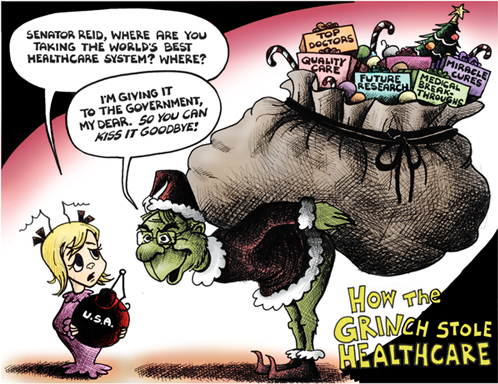
Cartoon: How the Grinch Stole Health Care Sorry, Cindy-Lou Who! Say goodbye to the world's greatest health care system.
Choice Not Consensus: A Plea From a Less Important State Do Iowa and New Hampshire have undue influence over the presidential nominating process? Payroll tax holiday blues
One can fault House Republicans for many things, but opposing an extension of the payroll tax cut and another extension of unemployment benefits is not one of them.
Whether one agrees with the issue or not, the fact is, the House has already passed extensions of both of these items. At a cost of $180 billion, those extensions would last for the duration of calendar year 2012.
Yet, to read the headlines, and to listen to the White House's talking points, House Republicans are intransigently opposed to the plan, and just want to stick it to the "middle class" on Christmas. How dare they!
"Obama Says Payroll Tax Cut Blocked by 'Faction' in House," blared one headline. "House Republicans reject 2-month payroll tax cut," declared another. "House rejects payroll tax cut, jobless benefits," still another stated.
There's only one problem. It's just not true.
It's a talking point. Not news. Not even remotely factual.
What is true is that the House and Senate have not yet agreed on the details of that legislation. While the House has passed a 12-month extension, the Senate has merely kicked the can down the road for 2 months.
Usually when that happens, as anyone who has passed a basic lesson on civics could tell you, there's a conference committee, wherein the House and Senate will work out their differences. Heck, it's even in the Constitution.
After all, the House is under no more obligation to pass the Senate version of the extension than the Senate is to pass the House version. Which is why the framers envisioned a conference committee.
And, that is exactly what the House has voted for.
By a vote of 229 to 193, the House voted in the affirmative on a "Motion to Go to Conference". Not even on the Senate bill. It was declaring, in effect, that it has already voted on this piece of legislation, and that both houses now need to hash out their differences.
Get full story here. 11 Big Gov't Busts of '11: #5-The Fast and the Furious
Video by Frank McCaffrey
Get permalink here. How the Grinch Stole Health Care
Get permalink here. Choice Not Consensus: A Plea From a Less Important State
Most registered Republicans will not pick their party's presidential nominee this election. Because of a curious tradition in our electoral process, voters in a handful of small states will get to anoint a frontrunner early this winter.
Now, granted, Iowa, New Hampshire and South Carolina don't always decide a presidential nominee, but we know the drill. Candidates all but live in these early states. Voters, particularly in Iowa and New Hampshire, are wooed and courted, and some are even known by name. These ordinary, unknown Americans resemble, for a fleeting moment, unlikely tie-breakers in an urgent moment of national deadlock.
In 2008, with no early GOP frontrunner, some of the talking heads were delighting in the prospect of a floor fight at the Republican National Convention to select a nominee (Romney, Rudy Guiliani and Mike Huckabee led, with John McCain rounding out the field). Of course, John McCain secured the nomination surprisingly early (March), thus by the time North Carolina's primary rolled around, no GOP contender had come to town or called my home or even run an ad. While that scenario is not a guaranteed repeat for 2012, it's not unlikely, either. Just ask voters in Indiana and West Virginia (also with primaries in early May).
Interestingly, the Gingrich campaign recently announced plans to launch a committee in North Carolina, with former state GOP chairman Tom Fetzer heading the effort. Party officials are enthused that North Carolina could matter after all. Yes, after all. Indeed, my vote might very well count.
But therein lies the point of the matter — why should states have to fight for relevance in the nominating process? Why should the voters in New Hampshire and Iowa have a greater say in deciding a presidential nominee over the party faithful in Arkansas (primary in late May), Utah (late June), California (early June), New York (late April) or New Mexico (early June)? I ask rhetorically, of course, as I know that the states, according to the Constitution, set their own primary dates).
Get full story here. |


 By David Bozeman

No comments:
Post a Comment